See your external asset surface as it actually exists.
Asset Intelligence gives teams a living view of domains, public IPs, pages, ports, DNS, certificates, and related signals, with the context needed to understand what changed and what deserves attention.
Not just an inventory
A basic inventory tells you what should exist. Asset Intelligence helps you see what is actually observable across monitored domains and public IPs, how that picture evolves, and where it may deserve attention.
It is designed for teams that need more than periodic scans or disconnected snapshots. The goal is a current picture of exposed assets with enough history and context to interpret change over time.
Current asset picture
Understand what assets are in scope and how they present externally across pages, ports, DNS, and certificates.
Change over time
Preserve sequence and history so new, changed, persistent, and disappeared conditions can be read in context.
Signals that can be interpreted
Move from raw observation to events, findings, and supporting evidence without losing the underlying details.
From summary to evidence
Asset Intelligence is organized so teams can move from orientation to evidence. Start from the asset overview, then go deeper into ports, pages, DNS, certificates, similar domains, organization context, events, findings, and reports.
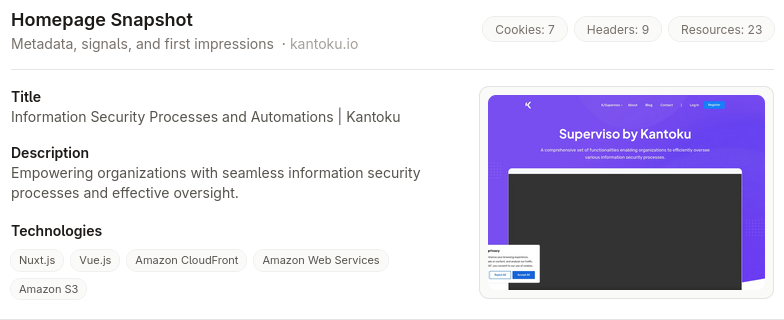
Page monitoring adds more than screenshots. Depending on the page, teams can inspect technologies, headers, cookies, resources, console logs, and redirect behavior to understand what is actually being served.
Read change, not just state
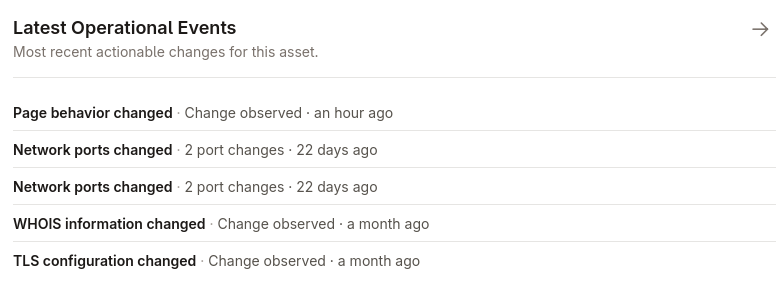
Asset posture is rarely static. Domains gain new pages, services appear on new ports, DNS records change, certificates rotate, and similar domains emerge. The operational value is often in the fact that something is new, changed, unexpected, or no longer present.
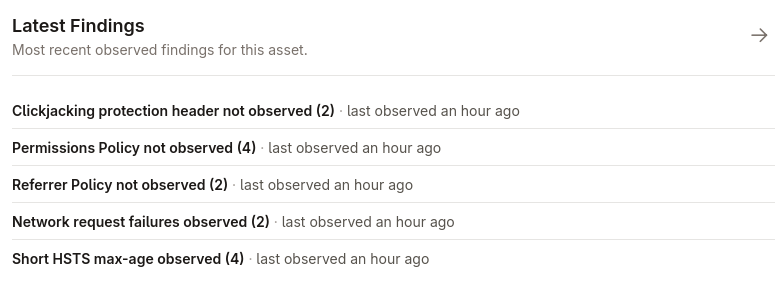
Events explain what happened. Findings highlight what deserves attention. That distinction helps teams review change without treating every observation as an issue.
Built for investigation and sharing
Asset Intelligence helps teams investigate findings with supporting evidence and communicate the current picture more clearly across technical and non-technical stakeholders.
Reports package the state of an asset when that picture needs to be shared outside the live product views.
Similar domains
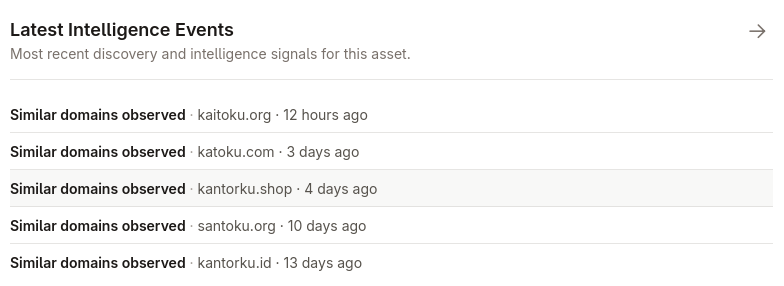
Monitor lookalike and adjacent domains to spot potential phishing activity, brand abuse, and trust risks earlier.
Similar-domain intelligence helps teams investigate suspicious domains in context instead of treating them as isolated findings.
Create an account and start a free trial
Start using the platform with a free trial and explore how Asset Intelligence and Superviso can fit your team's workflow.
Read the deeper docs
The docs go deeper on concepts, events and findings, similar domains, and reporting for teams that want the full product model.
Explore the documentation